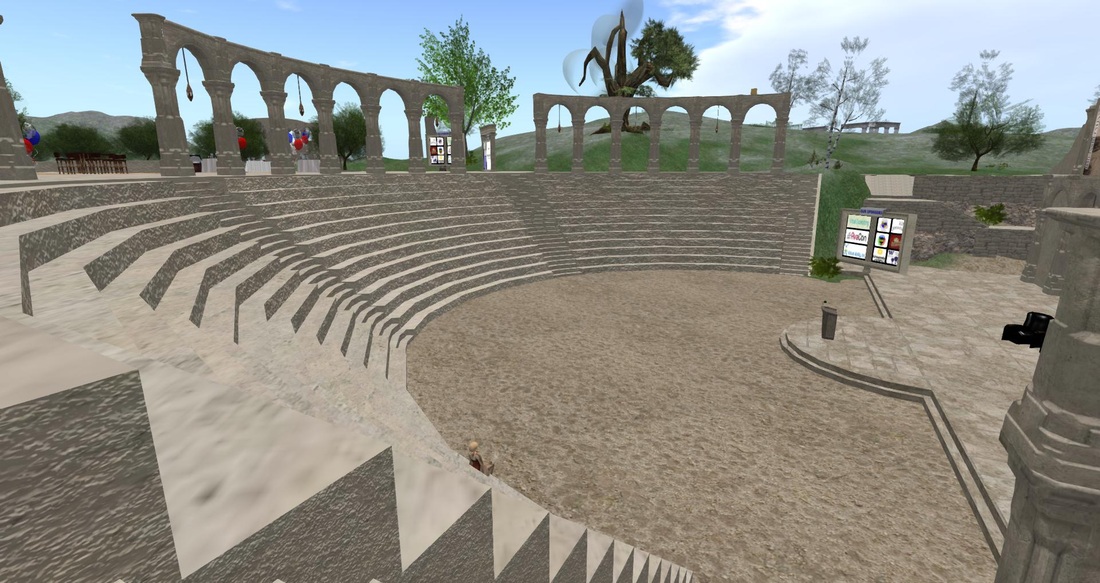
This has been an amazing conference. For this year's Virtual Worlds Best Practices in Education conference, with MachinEVO and CAMELOT Project representatives we gathered eagerly for Mr Ebbe Altberg's opening keynote on March 18th. At the SL Main Auditorium, the Chief Executive Officer of Linden Lab (the makers of Second Life®, BlocksworldTM, DesuraTM), announced their development of a new next generation platform with expanding possibilities and new features to improve quality and to benefit its users, including educators. It was great pleasure (and relief) to see that LL's CEO is so friendly, open and eager to include the educators' community in their plans and to take extra session time to answer our Questions and Answers at the end of his keynote. For those educators appreciating machinima or having 'land' in SL who have not got the time to watch all the talk, here are a few of his key points on Linden Lab's future plans on the next generation platform:
(not in speech marks in case there are possible inacuracies): As CAMELOT* Network Partner and standing for language teaching professionals interested in Teaching Machinima, it would be great ommission not to express how privileged and honoured Camelot would be to have a discussion with Mr Altberg surrounding educators in the current SL and the next generation platforms. Many thanks for being so open to and for the educational community. * CAMELOT stands for "CreAting Machinima Empowers Live Online Language Teaching and Learning". The project is coordinated by the University of Central Lancashire (UCLan), UK School of Language, Literature and International Studies. For past presentations in VWBPE, here are the links for Philip Rosedale's (CEO of High Fidelity and Founder of Second Life)and Ebbe Altberg's keynotes in VWBPE 2014. You may also wish to watch Philip Rosedale's TED talk on 'Life in Second Life' back in 2008.

0 Comments
ErlinaAzure in SL If all we lose is the Skin (after Richard Ashcroft's 'You on my Mind in My Sleep'), what is it that our avatars pull under within as educators and education professionals? My thoughts and energy are now self-directed towards incorporating Second Life in the teaching environment. The idea may not be new but it is based on the firmly-held belief that play is the best form of research and on the potential this medium has for further research in TEFL/ELT. Most reviewed literature so far focuses on higher and further education or teacher education, rather than school learners or other groups of the population and those learners who are challenged with certain disabilities. To ensure Young Learners' safety and save learner families from worries, we need to provide them with a safe and free (of charge and risk) SL environment through machinima we teachers have filmed for them. It is an easier solution until the possible development of a new free SL Grid for YL or an easy-to-use safe desktop platform, or console SL software (which could create LL young clientele). It is a more immediate solution than having to wait for laser holographer Patty Rangel's idea of Avatar Holographic Projection to reach every real-life stage and consequently every classroom around the world in my generation of language teachers. All we can do as educators is offer them the pedagogical and didactic oppportunities they deserve for language in use through machinima, a new form of edutainment and engage them in languistic production. The process below may not be as immersive as inworld learning, which adult learners have the privillege to enjoy, but it is still engaging and fully experiential. Even if it does not offer the benefits deriving from geospacial representation, identity, social norms, cognitive, affective and linguistic processes are still activated throughout the process of real-world machinima-making. Still, it is a clear indicator of teacher good will and allows plenty of room for storyboarding, script-writing, audio recording and performing scenaria on footage the teacher makes for their YL classess in SL. Research carried out at Peachgrove Intermediate School, New Zealand (Faloon, G., Janson, A. & Janson, R. 2010) suggests that both higher order thinking (analysing, evaluating, creating) and lower order thinking (remembering, understanding, applying) can be achieved through virtual world instruction. Judging by personal experience as self-directed member of the MachinEVO2015 and EDSL2015 groups of language educators, the learning process is motivational and activates strategies and competencies. With the benefits of gamification in education becoming more obvious through research, educators, parents and policy makers are changing their outlook to institutionalise it as an educational tool. Besides all this, it is the nature of the task and carefully selected staging that promote learner participation and can ensure the linguistic quality of learner output. Give them plenty of space for initiative and, for their peers, they can produce miracles, regardless of their age. But how can you embed and promote your driving force as teacher through this relatively new aesthetic and powerful tool packed with contextualised information? And how much can you invest in time and finances to convey the knowledge, ideas and values which your grandmother so successfully entertained and instilled in you through free-giving tenderness? In actual fact, through this channel, you can promote family values and best practices in the classroom or in your scientific field. To produce your machinima, some say it only takes skill; others, believe it takes imagination. It has to be both. It is a combination of IT skill, fruitful imagination and educator competencies. But most of all, it is yet another teaching medium, an effective tool expressing professionalism and care for your learners. Since we live in a 'Modem world', whichever angle you see it from, you can still produce first class lessons through this medium to please the most difficult of your little etrotters. Here are some ideas for representative activities you could implement on your course, depending on the age of your learners and lesson stage.
...to mention but a few. Out of respect for our little ones and to ensure best practices in our classroom, YL can watch teachers' screen captures (clips or photos) of your avatar(s) in sim, on their classroom Interactive Whiteboard, which may not be as immersive as inworld participation but can still provide realistic opportunities for meaningful practice, authentic involvement and genuine motivation. As learners appreciate the benefits deriving from drama activities and project work in class, you can invite them to devise the characters, scenaria and script to serve the purposes of your lesson and show them footage you have made on these lines. Although this is an ELT author's usual job, you will be amazed at the outcome of young learners' contributions in script-writing, directing and dramatic skill. There is significant literature on the procedure which to follow, with CAMELOT* providing a storyboard template for educators. Marisa Constantinides has also developed a comprehensive guide of 19 lucid steps for teachers, including technical considerations to follow when making machinima in SL. Nevertheless, here is my own reflexion of the practical steps I find useful in class to activate Young (but also Adult) EFL Learners, shifting the angle towards their language output. Be prepared to employ your best classroom management skills for this. Steps for TEFL Classroom Use Steps 1 & 2 mostly involve teacher preparation activity, 3-8 promote learner oriented action while 9 can be carried out by the teacher or technologically-geared students, and 10 is collaborative. In terms of linguistic involvement on the learner's behalf, I have divided this process into three parts: Pre
While 3. Learners write a general outline of their storyboard (group or individual work) 4. With a working screenplay in hand now, it is easier for learners to determine in detail the scenes and assume roles that suit them best (promote autonomy at this stage) 5. The write up of dialogues and narration can be done cooperatively in groups/pairs with prompt monitoring from the teacher, or individually per scene after class discussion, or it can even be set for homework. 6. Class, peer correction can take place now -final teacher correction before returning the script for rehearsing. 7. Workshop on Phonology and rehearsals 8. Audio Recording (this may take the form of out-of-class work, in the breaks or for homework with learners' digital desktop tools) After 9. Post-production: compiling audio and video files, adding background effects & music 10. Class viewing, feedback & evaluation One variation of step 2 in this approach - if you wish to make this stage less guided and depending on the class size - is to log into SL for screen captures after you have got group suggestions and guidance (on characters, locations, props, costumes) - a tailor-made approach, more learner-centred. For this, you may need more than one avatar in which case you can either make use of your colleague-friends' avatars or you can create multiple of your own (up to 5 permitted per landline). Another variation of step 2 for recycling the course material is to provide learners with a role card with instructions, or the outline of the scenario or just the title of the storyboard and allow them the time to brainstorm the script (dialogue, narration and set-up description) for a machinima or inworld role play instead of acting it out as a drama activity in the classroom. Choose costumes for your avatar and embark on unscripted production of the language in focus. Be sure to compile a machinima of your end-product on which to base feedback and further revision. Niki's suggestions for a better world came as a natural end-product to activate the language, with the learner using a lot of her own ideas and adding her experience in her geographical location. She took initiative to choose the scenes from the footage I had made and insisted on audio recording her voice and self-correcting several times before reaching the high standards she had set herself. Here is the result: Wherever Avatars go after logging off, they still hold their dearest ones in their heart even in their sleep. This is Helena Galani (aka ErlinaAzure) in SL For further reading, you might want to try:
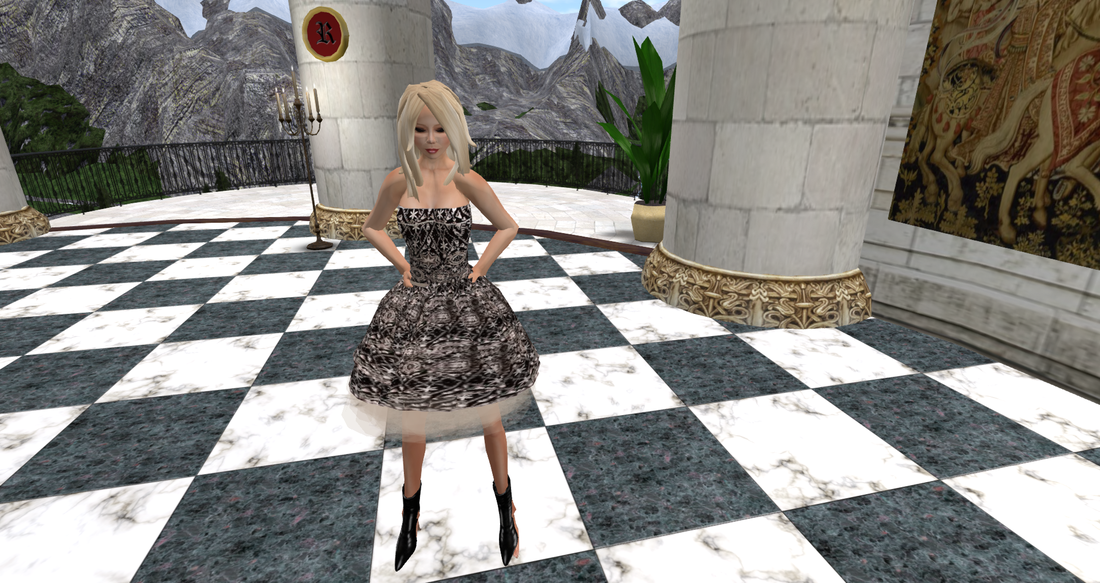
CAMELOT is a two-year funded EU Project for language educators, coordinated by the University of Lancaster (UCLan), School of Language, Literature and International Studies and it stands for ‘CreAting Machinima Empowers Live Online language Teaching and learning”. The project investigates the use of machinima through a task based approach developing a teacher training to facilitate educators with their own use of machinima. Thank you to Carol Rainbow, Dennis Newson, Christel Schneider, Shelwyn Corrigan, Alfonso Garavito Olivar, Hazel Workman, Ann Nowak, Marisa Constantinides and Dr Michael Thomas, Dr Randall Sadler and Heike Philip (to name but a few) for their boundless free-giving. Hello Friends! This post has been inspired by those few learners who come to challenge their teacher's skills. It is for all my friends and colleagues who breathe only to cover their most difficult learners' educational needs, to motivate them and to help them improve their performance. It comes as a natural next step after years of work with inspirational and progressive colleagues, employers, and parents. And it is also inspired by my recent experience with dedicated and skillful MachinEVO2015 moderators and coordinators who have been focusing on the use of Virtual Worlds to facilitate learning languages. This post does not simply refer to gamification. It comes as a natural consequence to reflect on the idea that innovation and creativity have been taking place throughout generations and they never stop. The average EFL learner may feel content with their books and (if lucky enough) an interactive whiteboard, but what about those who have been born with their finger on their game consoles? The majority of our students, especially the younger ones, have been playing Virtual reality games in their free time, so much so that they acquire new language from their favourite heroes - on a positive note - or get distracted from their school work -as a downside. However, Second Life® three dimentional virtual world gaming does not compare with other online or desktop experiences. So, why not try adding a totally new dimension in your everyday classes along with your coursebook or encourage your learners for some self access practice at their own time. You can get them to watch and make online machinima or, if they are adults, to 'go Inworld'. Using virtual world senaria in the classroom can be a most illuminating experience for your learners or your trainee teachers. Through Second Life® you can give them stimuli on which to observe, conceptualise and experiment by using role-play simulations for instance, to introduce new language, to help revise, practise or consolidate. Take my experience in Second Life® with the Gomez Family as an example. How would you feel if during the flight you fell off the plane and ended up at the bottom of the sea hairless, then having to fly after your plane? What language would you need to use to express frustration, amusement, complaint or anger to the pilot (Alfonzo Garavito Olivar aka Alfonzo Perfferle) or cabin crew? For language teachers, this inworld experience can inspire them to teach language connected with aviation or story-telling. For EFL learners, this simulation can stimulate their writing or speaking skills, for example. The future of storytelling has now changed through this medium which adds a new expression! You can use teacher-made or learner-made machinima for distance or blended learning, for in-class instruction or for learner/teacher self access. Or you could get your learners to make their own machinima but, mind you, it is not for inworld use with young learners as one needs to be 18 to enter Second Life. This may be a consideration for Second Life researchers and Developers to bear in mind if they are considering opening SL up to education. Still, to appeal to their young learners, teachers can use child avatars to promote their teaching aims. By using such a totally immersive environment as Second Life® (which is free and safe and should stay free especially for educational purposes), your classroom mirrors real life, promoting thus not only linguistic development but also social development, intercultural awareness, creativity, resourcefulness and multiple intelligences. It helps them improve their concentration levels, build determination and creative thinking. However, you need to carefully prepare lessons with linguistically relevant tasks on SL experiences, to activate your learners' target language skills, to help them express their cognitive and healthy emotive capacities. In case this is disregarded, you are bound to end up with a class using their own mother tongue. With a group of like-minded, well coordinated and cooperative educators, new material (machinima), tasksheets and holodecks can be created to promote learner reflexion in all languages, on situations resembling real-life or even inconceivable experiences such as dancing the night away with 'King Osna' and friends at 'Castle Renoir', flying to catch your plane, hugging the universe in a cosmic sci-fi galaxy or getting it off your chest at the Speaker's corner in Hyde Park - you name it. For those who are interested in the inside story, this very innovative medium of teaching has opened up horizons for scripting to build new scenes and to make your objects move, speak and interact like real life agents. So, what do you think? Get a Second Life® and Enjoy the experience ErlinaAzure (& Baby Tux) in SL BBSoon If you wish to learn more about machinima, you can read Christel Schneider and Carol Rainbow's 'Making and Using Machinima in the Language Classroom' on Scribd. Highly recommended! |
Please cite for any content you use from this web page.
Helena Galani, Archives
January 2021
Categories
All
Στους γονείς οφείλομεν το ζην, στους δε διδασκάλους το ευ ζην. |