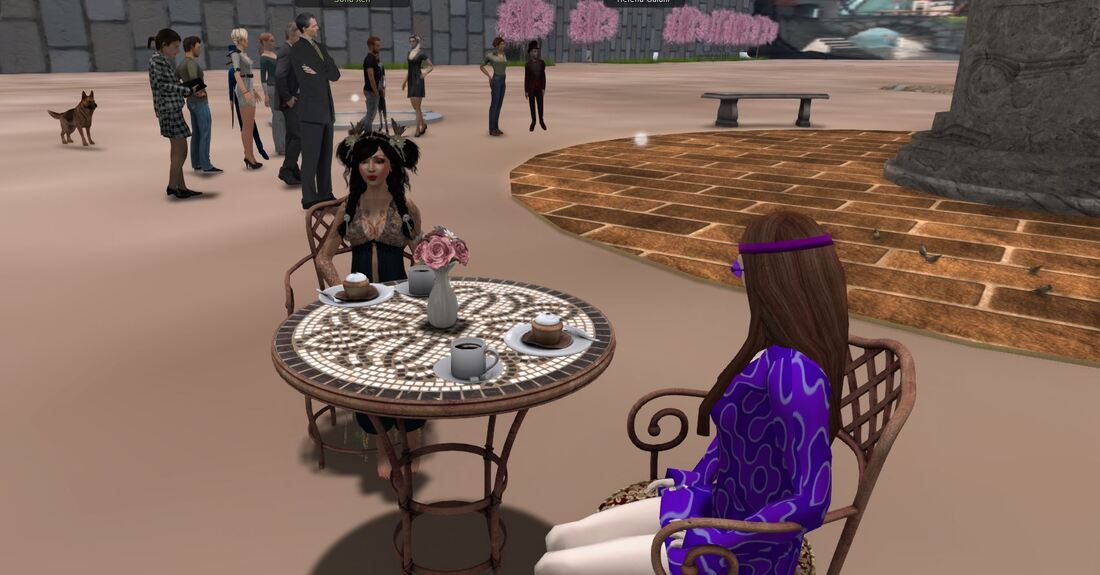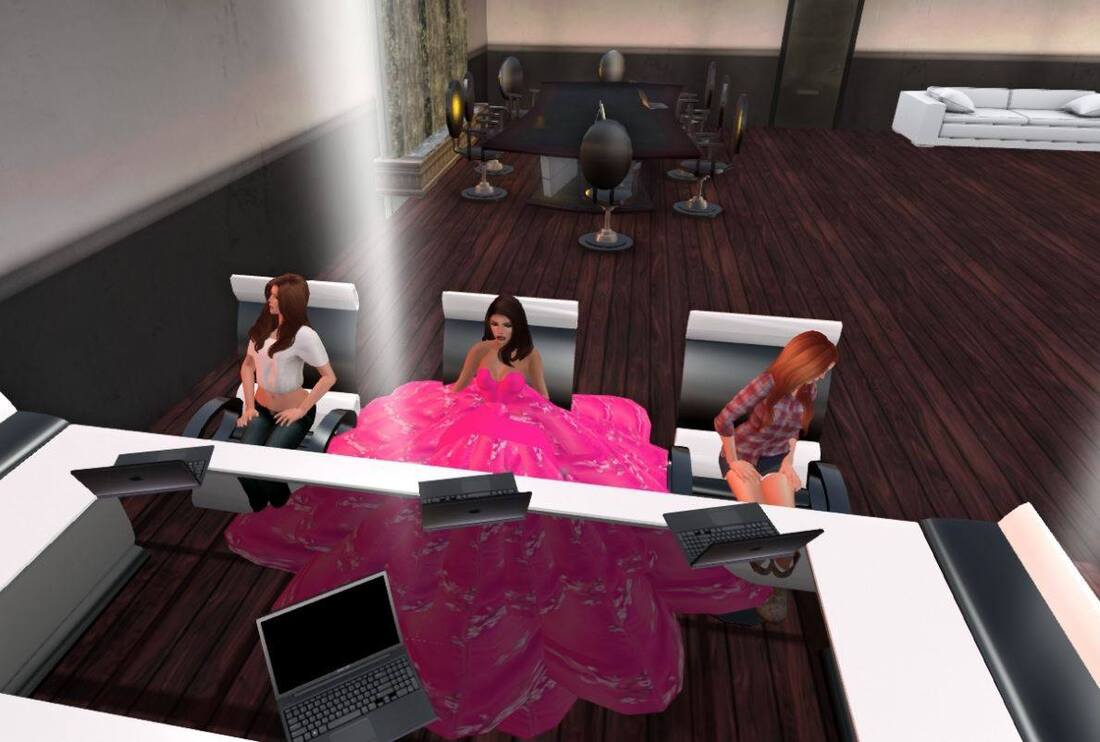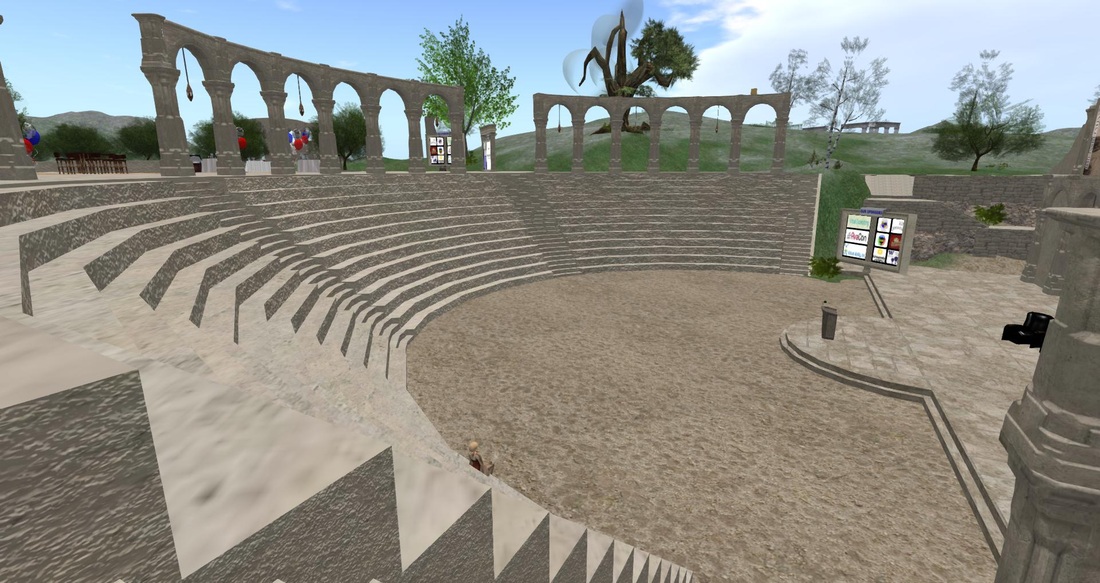
It is common practice for citizens of the 21st century to use different online media for their entertainment, communication or different forms of daily self expression. Taking this habit into account, the use of Transmedia Storytelling has become an indispensable part of our lives. So, what is Transmedia Storytelling and how can it be encompassed in language teaching in multi-user Virtual Worlds? Here is a detailed article documenting my experience with my students on ELT Treasure Island, Kitely, so far. My presentation and moderation at Immersive Storytelling, EVO 2021 focused on how to promote Transmedia Storytelling in our classes in Virtual Worlds. On our Transmedia Storytelling Project on ELT Treasure Island, the learners have been very creative, producing comics, storybooks, podcasts, paintings, gallery exhibits, machinima, blog posts. Here is a learner introduction to ELT Treasure Island, in the form of a postcard and a playlist for my trainee teachers on EVO 2021, with machinima and instructions on how to use some of the affordances of a Virtual Island.
0 Comments
There are a lot of approaches to teaching languages in virtual Worlds. It is up to you and your teaching aims which one to choose. However, the plethora of in-world affordances and online educational tools available can make it an unprecedented experience for both your learners and yourself. Here is a machinima that outlines how you can employ virtual worlds in class. You can go exclusively in-world and have real-life (or unreal) simulations with your avatars. (Adult beginners) You can have grammar lessons and promote language in use. (pre Intermediate) You can recycle language or literary material through immersive language games. You can help learners practise language simply through the use of the chat box. You can teach shapes, colours, textures through building in-world. You can teach them to add script, texture, animations use HUDs, teleporters, rezzers. Learners can make their own machiniLOG about their everyday learning experiences. There is an inexhaustive list of activities you can do with your learners. This is the first in a series of posts on how to teach in a 3D Virtual World. Online teaching, synchronously or asynchronously has been a necessity for quite a while now.
Recently, an increasing number of educational establishments and teachers need to feverishly prepare to shift their face-to-face classes to online only. Apart from a user-friendly Learning Management System and applications, to maintain learner enthusiasm in an engaging environment, it is useful to provide online face-to-face meetings. They offer an instantaneous and flexible support solution, improve team collaboration, reduce stress, and they also remove geographical limitations. Here is some essential advice based on my experience on how to embrace your remote digital classroom through web-conferencing software and how to maximize value for your students. The use of online meetings or conferencing tools, for Remote or Blended teaching, may not be complicating but there are still some basics you need to know before embarking on your online courses, especially if you decide to record your synchronous lessons for the class LMS (Learning Management System). There are a lot of web conferencing apps to this end and the choice is up to you but technically, here are some areas to bear in mind: Positioning: First and foremost, when teaching online, be sure to place your webcam (unless you have a built-in camera) in front of you at the level of your eyes (just about equal to your hairline) at a reasonable distance, and angle the screen so that students do not only see the top of your head or a headless neck. You may have to place your laptop or screen on an object for this. Everything should be centred; your light and you are centered to the lens. You need a well-lit room with white light coming from the front rather than the side or the back (NO windows behind you, no fluorescent lights in the room) so that your facial features are softer. You can place a cheap LED light or a simple desk lamp right over the lens of your device to set up on your desk, or open a white screen in front of you (not underneath) on your computer for that purpose. Also, you can have light coming through a window in front of you and you may optimise your camera settings (White Balance & Brightness/Focus) but otherwise put the rest of the blinds down. Varying your positioning helps maintain learners' attention and encourages participation. For example, you can move forward, reduce the distance and get closer to the camera or to the sides of the screen and only move out of view completely when you want to show your learners objects such as flash cards, puppets or realia. Instead of looking downwards a comfortable chair with a back will help you vary your positioning, which will create a positive atmosphere. Background: Keeping the background behind you as simple as possible will not distract your students. A cluttered wall will not help them focus on your classwork. Instead, unless you have no paintings to display, you can select from the platform backgrounds (for example while on Zoom) or a photograph you have uploaded or a picture of a virtual world. Overall, keep it uncluttered and reduce visual noise to maintain attention! Eye contact: You may think it is difficult to keep eye contact with your students during online classes but in fact you can make the most of the camera position to show that you pay attention to what they contribute and that you are interested. Looking at yourself on the screen is not the best idea. Don't be afraid to move closer to the lens or to move an external camera around and use facial expressions to indicate approval, encouragement and positive feelings. It is also advisable not to look down at the keyboard for most of the lesson, but to look at the camera (not the screen) in a friendly manner instead which creates the effect of looking at your students straight in the eyes. Looking at your learners' faces is also essential to check whether they follow the pace. Do not forget to look into the camera, not the screen, and avoid showing your forehead part. It will make more sense to your audience to look at you when you look into their eyes. Body language: As only the upper part of your body is visible to your students, it is important to use gestures for prompting and find your own type of gesture to indicate you are pleased with the course of the lesson. My students and I find it particularly entertaining to 'high-five' each other in front of the camera lens. Virtual reactions that some online platforms offer are also a good way to vary the pace of the lesson and to create a positive atmosphere and release stress the new technology may inflict. It is essential that you smile to show that you are confident with the material and the technology you have selected to use. Voice & Sound: It is essential that you test your sound tools and volume before the lesson begins. This is to ensure that your students will not hear a whisper or a deafening sound. Although it is useful to vary the volume, you still need to make sure it does not harm your learners' hearing and it does not distort the quality of your voice or listening material. By varying the pitch and pace of your voice, you will not sound monotonous and your audience will also be entertained. You can even exaggerate a bit and by all means do not hesitate to use your drama skills. Don't use the built-in microphone of your web cam or laptop. Get an external USB headset or a podcasting mic you may have. Anything else is better than built-in microphones. Preparation: It generally depends on your teaching style but there is an element of entertainment during online lessons. The nature of technology itself is more fun and satisfies the expectations for variety in class. It caters for different learner styles and stirs learner curiosity to research more after class. Obviously, it helps to have clear-cut teaching aims, to know your tools before using them and to be ready to provide solutions to parents or students who encounter difficulties before, during and after lessons. It is wise to have online notes with the links you will be using and open the links before class. Have your visuals at hand and practise using the Whiteboard, Annotations, Remote Access or Screen sharing tools before hand. Test your slides or desktop software beforehand and provide interactive activities such as games, puzzles, mazes or scenarios (the list is inexhaustible). Keep your register at hand to record absentees' names and provide them support and tuition before they return to class. Gradual exposure: At the beginning of courses, it so happens that learners may get taunted by the technology they are asked to use for learning. To avoid this, you can involve your students in gaining access to the material on your desktop by simply underlining and circling parts of the material or options on the Whiteboard (Zoom provides reliable settings for that). Start with simple technological tasks in the beginning and leave more demanding ones for later to encourage even your younger learners' participation. To get students to look forward to your lessons, vary the pace and exposure and increase the level of technological difficulty gradually throughout the course. For online classes, it also helps not to rely on lecturing only but to allow for learner talking time and, as with face-to-face classes, to invite student engagement and feedback throughout the teaching session. They may also miss old interactions at school so it helps when they are given opportunities to take part in pair or group work (such as in Breakout Rooms in Zoom). For best results, successful virtual teachers maintain communication by checking in by phone, text or e-mail with each student and their family — most often with those who are struggling with poor network connectivity or no access at all and substandard, if any, devices. They also employ other channels of communication that students are already familiar with, and blend with cloud-based Learning Management Systems for ubiquitous access to the material. Warmers & Fillers: To create rapport and help students unwind and release stress, have some warmers and fillers off your cuff. This can help with larger groups as they involve learners in using the technology less and in talking about themselves and their background more. These tasks can be based on accumulated knowledge and have an element of game play with the use of online tools. Many a time, a song, a board game a film clip, photos, crosswords, anagrams, drawing, screen sharing your Virtual world or simply the whiteboard of the platform you use can promote educational aims and help the class bond. More on this to come in a future post. Helena Galani (Dedicated to my friend Claire and teacher colleagues and friends who are faced with the new challenge of moving their classes online with little or no advance notice) On 18th March 2017 at the 38th TESOL Greece International Annual Convention, Letizia Cinganotto and Heike Philp (simulcasting from Italy and Brussels/Germany respectively) and I presented "“Out of this World – eclectic honeybees in holistic VWs" in Athens, Greece. The presentation focused on the use of immersive Virtual Worlds for language education purposes and you can find our interview here. My presentation slides are available on a slideshow below and the recording of the online simulcast can be viewed here It was great pleasure to be welcomed by such an enthusiastic audience and a very warm team of hard-working and eager coordinators at the TESOL Greece Convention. Kudos to Valia Gkotsi (Chair), Georgios Chatzis (Vice Chair) and the organisers of this year's International Annual Convention.
Many a time have you asked your learners to prepare for the next class. Even as students we remember our teachers urging us to do so. But which method do you find most effective for this and what educational tools do you employ to encourage your learners into it?
Flipping lessons is admittedly a highly effective way of distributing your teaching material for learners to prepare before arriving in class and to promote learner autonomy, retention, retrieval and consolidation of your lesson aims. Aaron Sams with Jon Bergmann (Woodland Park Colorado) are pioneers of the Flipped Class movement and founders of The Flipped Learning Network. In this video I have translated for you into Greek, Aaron briefly explains how he flips his classes. * * * * * * Ουκ ολίγες φορές, έχετε ζητήσει από τους μαθητές σας να προετοιμάσουν το επόμενο μάθημα. Ακόμη και σαν μαθητές θυμόμαστε τους δασκάλους μας να μάς παροτρύνουν τα το κάνουμε ακριβώς αυτό. Αλλά ποια μέθοδο βρίσκετε πιο αποτελεσματική γι' αυτό και ποια εκπαιδευτικά εργαλεία χρησιμοποιείτε για να ενθαρρύνετε τους μαθητές σας να το εφαρμόσουν; Η αντιστροφή των μαθημάτων είναι ομολογουμένως ένας άκρως αποτελεσματικός τρόπος διανομής του εκπαιδευτικού υλικού σας ώστε να προετοιμάζονται οι μαθητές πριν φτάσουν στην τάξη και για να προάγετε την αυτονομία τους, την συγκράτηση, ανάκληση κι εμπέδωση των στόχων του μαθήματός σας. Οι Άαρον Σαμς και Τζον Μπέργκμαν (Γούντλαντ Παρκ, Κολοράντο) είναι πρωτοπόροι του κινήματος της Αντεστραμμένης Τάξης και ιδρυτές του Δικτύου Αντεστραμμένης Μάθησης. Στο ακόλουθο βίντεο, που έχω μεταφράσει στα Ελληνικά για εσάς, ο Άαρον σύντομα εξηγεί πώς αναστρέφει τα μαθήματά του. <iframe width="560" height="315" src="https://www.youtube.com/embed/2H4RkudFzlc" frameborder="0" allowfullscreen></iframe> For the third annual SL MOOC 2016, Second Life® was at its best once again, with amazing professionals in the field of teaching in Virtual Worlds, presenting, amongst an array of topics and prominent professionals, different aspects of using virtual environments to enhance their learners' educational experience. On Pionia Destiny's (Doris Molero) plot, Heike Philp enthusiastically presented the outcome of EVO ViLLAGE 2016* and the moderators' team, together with the usefulness and necessity of training teachers to create games in 3D world. On 28th April 2016, on EduNation Island, with my presentation "Lessons from a Skybox - Using SL immersive environments to teach EFL", I explained how 3D World can bring on positive backwash effect for different types of learners on exam oriented classess. Based on a short scale survey, learners find lessons in Second Life® useful, interesting and friendly. According to this mini survey, confidence is boosted in the target language, learner concentration span increases, course participants prepare for real-life scenarios and they become more observant through "digital events" in this VW. Through holodeck scenes especially created for the purposes of language lessons, learners are given witty tasks to carry out which encourage language in use, natural communication and promote language development, while at the same time learners acquire new digital skills which enhance cognition and different domains of learning. The third annual Second Life MOOC 2016 was an unforgettable series of educational events wonderfully hosted by Dr. Doris Molero (Prof. English, Urbe University), Dr Nancy L. Zingrone (Prof. Psychology, Northcentral University), and Dr Nellie Deutsch (Curriculum Consultant, Online Facilitator, University of Phoenix online). (Pionia Destiny, Maggie Larimore and Nellie Homewood, avatar names in SL). The MOOC took place from April 1-30, 2016 and its theme this year was "Connecting for learning in Virtual Worlds". On my part, I presented an aspect only of the multi-purposeful, interdisciplinary use of 3D environment, for the purposes of teaching English as a Foreign Language. Thank you Doris, Nellie and Nancy. Looking forward to more SLMOOC events to come in the future. Helena Galani * EVO ViLLAGE stands for "Virtual Language Learning and Gaming Environments" It has been almost a year now since I embarked on MachinEVO course for language teachers online. Since my CAMELOT award (1st prize) and as Moderator of this year's EVO ViLLAGE, I have developed a new approach to viewing teacher education which opens up new paths to education and teaching. All this along with my personal strong convinction of the usefulness of Virtual 3D environments in education, encourage me to reflect on my own experience during the 8th SLanguages Annual Symposium 2015 (which I had inadvertently omitted) . The Symposium came as a most outstanding event just before the end of a year characterised by vigorous activity at all levels in the world of education. With EduNation Island, Second Life® being a hive of activity for many years now, the Symposium came, once again, to confirm the ongoing effort, unfaltering energy and care which are invested in quality education to create and maintain learner supportive environments, to improve living standards, and promote levels of sustainable development. During the 8th SLanguages Symposium, speakers from around the world reflected on their recent professional experience with teaching and researching in 3D environments. Moderated by Professor Randall Sadler, (University of Illinois, Dept. of Linguistics, co-owner of EduNation islands in Second Life), Heike Philp (co-initiator of EU funded LANCELOT, AVALON and the CAMELOT project), Christel Schneider (Research Assistant for the CAMELOT Project at the University of Central Lancashire, founder of CSiTrain), Carol Rainbow (author, ICT consultant & teacher trainer), Helen Myers (teacher of French, Chair of London ALL), Shelwyn Corrigan (Learn IT Town, University of San Fransisco), Ann Nowak (ELT teacher), Hazel Workman (3D animator, technology consultant) and Helena Galani (ELT/EAP educator, assessor), the successful event provided ample evidence of the tireless and powerful work being done in Virtual Worlds for education. Amongst other prominent presenters and researchers*, Keynote Speaker Stylianos Mystakidis (Learning Technologist and E-learning Manager, University of Patras, Centre for Vocational Training) focused on "Social Virtual Reality: Open Education’s Surprising Secret Sauce" by guiding us through a series of exciting activities to stimulate learners' mind in our classrooms. On 14th November, the first day of the Symposium, surrounded by an enthusiastic and creative group of like-minded colleagues, I presented the usefulness of "SL Machinima for Young & Teenage Learners". The recordings for my presentations can be viewed on the SLanguages webpage and my slides are uploaded here: Also, below please find the slides for my presentation on "From Board Games to Role Plays" (15th November, 2015). The transformational experience in Virtual Worlds goes on and it has a lot to offer to all levels of education.
More news is coming up soon about this year's running TESOL EVO Virtual Language Learning And Gaming Environment course for teachers (EduNation Island, Second Life, 11/1 - 14/2/2016). Helena Galani * 8th SLanguages Annual Symposium Speakers:
TO CREATIVITY Through this post, I would like to present how I see metaverse can promote 'eu zein' (το εὖ ζῆν /ef zin/, wellbeing in ancient Greek) as a teaching medium in the language classroom. After all, “Life I owe to my parents, virtuous life I owe to my tutor.” as Alexander the Great put it ("Στους γονείς οφείλω το ζην, στους δε διδασκάλους το ευ ζην"). So this post approaches learner and teacher skills and competences from a different angle as there is already plenty of literature on the 8 interdependent Key Competences or the 21st century 4 Cs. This entry is dedicated to our parents and teachers and to G. (Syrmas)Vizyenos, the Greek scholar, poet and pioneer of short prose whose study in 1881 focused on the use of play from a psychological and pedagogical perspective.(1) As founder of contemporary Greek narrative, he opened the path for a new literary form of prose with his inventiveness. It comes as bitter realisation that, as a medium carrying strong messages about life and human existence, Literature (or literature) tends to be omitted in most EFL textbooks and classrooms as it is, wrongly, judged to be impractical in serving specific linguistically structural aims. Instead, it is amplified in mother-tongue language studies or on language degree courses in Tertiary Education. For non-native speakers of English, we should not be too fast to rule out the significance of 'divine literature' in stimulating learner language development, in enhancing sensitivity to language-in-use, in appreciating literary style and, eventually, in promoting life ideals and shaping personality. If coursebooks are not strong enough a medium to illustrate all this, then TEFL machinima may be a more powerful tool to catch learner attention to this linguistic genre, with special reference to Young Learners. With all the animation, music, visuals and game effects simulating real life, educational literary machinimas in TEFL can act like an attention-grabber of, otherwise, easily distracted learners who would much rather spend their days playing inworld games. With parents generously investing in their children's use of technology for gamification or communication, why should language teachers neglect the ubiquitus of metaverse to tackle learner varied paces and multitasking habits? In other words, in a world where technology has become second nature, interest in the study of literature through this medium - and in particular, 'literary TEFL machinima' - justifies the most tech savvy learners' high expectations at any age. It comes to promote appreciation of the aesthetic significance of literary works without running the risk of demoralising the learner in the process of literary analysis, semantic, phonetic or stylistic interpretation. Whatever the lesson aims, focus on pedagogical stylistics through machinimas can be employed as a means to promote the functional significance for text analysis through intuitions, interpretative skills, class research on locutionary/illocutionary/perlocutionary acts. Similarly to 'Lives I', the second episode also promotes what would otherwise be a reading activity, through an oral communication chanel as most people tend to resort to and to be exposed to oral sources of input out of convenience nowadays. Without disregarding learner types/learning styles ofcourse, the reading skill is - for most younger learners who have not received training to expand their concentration span - an overly demanding skill requiring activation of multiple physical and mental processes. But this is perhaps a forthcoming guest entry on my site. To go beyond the classical gap-filling, spelling, multiple choice, multiple matching or sentence completion types of exercises, I suggest more teacher-friendly exercises that promote learner interpretation, reader exploration, involvement and reflexion. or, eventually, discovery of author intentions. Whatever the original aims of the writer though, meaning and Interpretation are always in the eye and the ear of the beholder, as long as there is language produced, the text is not deconstructed 'irreversibly' and there is no shift of focus from the lesson aims. Interpretation of literary texts in the EFL classroom is always subject to the predisposition or age of the interpreter and their overall life stance. To encourage learner participation, class bonding and literary appreciation rather than depreciation, clear selection of tasks is of utmost importance. Since language is a social fact, as social actors, learners can be assigned any of the following meaningful, purposeful and less mechanical tasks, in groups or individually through the aid of ELT literary machinimas - subject to their age range - to grasp the interrelationship between poetry or prose with real life. The level of difficutly is mainly determined by the type of task(s) set in relation to the literary text:
With particular reference to making language learner machinimas in response to my literary one ('Lives II'), my younger learners instantaneously absorb the target language as part of a game process. It is more pleasant and meaningful to recite a poem and a rhyme or set it to music than to memorise a bilingual list of new words which are never to be stored in active long-term memory anyway. Montessori M. said that playing is a child's job anayway. Through play, both young and adult learners are cognitively involved, learn to take control of learning and become active communicators in charge of their own learning process. Students take more initiative and become the centre in a learner-directed class. It is not my intention to plagiarise possibly existing scientific evidence in the field but from empirical practice I come to confirm that through this relatively new medium of teaching, the learner develops cognitive and metacognitive control and gains personalised pursue of progress, achievement and reflexion on the language, cultures and learning processes. Whatever their age, with 'happiness hormones' released in their brain in a secure environment, learners are surely more eager and prepared to work towards immediate results by employing all their senses and monitoring feelings (own and others'), to better understand social roles and to manage thinking and behaviour. With the use of literature-integrated machinima (learner or teacher-made), all this is amplified to help the learner better process emotional information, develop emotional traits (eg empathy) and balance them to navigate their life and environment. With particular reference to my 'Lives II' machinima, to promote family values, Cultural awareness and appreciation, learners could carry out class research based on the notion of motherhood/fatherhood in their country or the origins of different types of music* In education, there are no winners or losers. Education is not about punishment, hegemony or on the other end, meaningless self-eudaimonism. It is every educator's aim to prepare unharmed and useful achievers with successful and positive experiences, thus saviouring and strengthening their uniqueness through incentives. If there is a wrong which might disturb our class balance, appreciation of the value of time is essential and this is best done by employing friendly learner-centred approaches to reach a solution and lead students beyond self-actualisation or metamotivation. Maslow explains this process (1967): "Self-actualizing people are, without one single exception, involved in a cause outside their own skin, in something outside of themselves". And ancient Greeks since Herodotus devoted themselves to being «καλός κ' αγαθός» 'good (handsome) and virtuous'. For aeons now, χρόνος chronos has taught us: there is no room for experimenting or resorting to time-consuming procedures since 'we are what we repeatedly do. Excellence, therefore, is not an act but a habit..' (Aristotle, 384-322 BC). The intended message to learners and teachers is that, if we are to accept the notion of transformative learning as the goal of education, it is essential to go through a self-igniting process materialising from within which leads to more humanistic dimensions beyond critical thinking. There may be more to life than Metaverse but this is also a brilliant place to start from, and all I am hoping to achieve is softly swing the cradle with one machinima at a time. ** Belly dance music - set as background music in 'Lives II' - was meant to wake up the earth and gods, and to symbolise female substance and idiosyncracy. It derives from rituals in the name of Aphrodite and Artemis to practise eugenics and bashful femininity. Arabic music originates from Byzantine echoes and Systema ametabolon, enharmonium, chromatikon, diatonon. (http://el.wikipedia.org/wiki/Χορός_οριεντάλ) The avatar's kimono encouraged discussion on Japanese and local costumes and occasions, and in my teaching set-up, it led to a discussion on the similarities between the Greek and Japanese mother role models. For further reading you may wish to try
Austin, J. L. 1962. How to do things with words. London: Oxford University Press Genette, G. (1980) Narrative discourse, Oxford: Basil Blackwell. Maslow, A. (1971) The Farther Reaches of Human Nature Todorov, T. (1966) 'Les categories du recit litteraire'. Communications, 8:125-51 (1) Vizyenos G., (1881) 'Das Kinderspiel in Bezug auf Psychologie und Padagogik' available on Anemi archive, University of Crete http://anemi.lib.uoc.gr/metadata/b/6/9/metadata-106-0000080.tkl (special thanks for the permission to use this link) Widdowson, H. G. (1975) 'Stylistics and the Teaching of Literature', Longman This post has been written with all my dedicated colleagues in mind; with all my respect to all miracle makers who support life. Also a big Thank You to Chic Aeon for her contributions and artistic quality work in Second Life. Helena Galani (aka ErlinaAzure in SL) This has been an amazing conference. For this year's Virtual Worlds Best Practices in Education conference, with MachinEVO and CAMELOT Project representatives we gathered eagerly for Mr Ebbe Altberg's opening keynote on March 18th. At the SL Main Auditorium, the Chief Executive Officer of Linden Lab (the makers of Second Life®, BlocksworldTM, DesuraTM), announced their development of a new next generation platform with expanding possibilities and new features to improve quality and to benefit its users, including educators. It was great pleasure (and relief) to see that LL's CEO is so friendly, open and eager to include the educators' community in their plans and to take extra session time to answer our Questions and Answers at the end of his keynote. For those educators appreciating machinima or having 'land' in SL who have not got the time to watch all the talk, here are a few of his key points on Linden Lab's future plans on the next generation platform:
(not in speech marks in case there are possible inacuracies): As CAMELOT* Network Partner and standing for language teaching professionals interested in Teaching Machinima, it would be great ommission not to express how privileged and honoured Camelot would be to have a discussion with Mr Altberg surrounding educators in the current SL and the next generation platforms. Many thanks for being so open to and for the educational community. * CAMELOT stands for "CreAting Machinima Empowers Live Online Language Teaching and Learning". The project is coordinated by the University of Central Lancashire (UCLan), UK School of Language, Literature and International Studies. For past presentations in VWBPE, here are the links for Philip Rosedale's (CEO of High Fidelity and Founder of Second Life)and Ebbe Altberg's keynotes in VWBPE 2014. You may also wish to watch Philip Rosedale's TED talk on 'Life in Second Life' back in 2008. ErlinaAzure in SL If all we lose is the Skin (after Richard Ashcroft's 'You on my Mind in My Sleep'), what is it that our avatars pull under within as educators and education professionals? My thoughts and energy are now self-directed towards incorporating Second Life in the teaching environment. The idea may not be new but it is based on the firmly-held belief that play is the best form of research and on the potential this medium has for further research in TEFL/ELT. Most reviewed literature so far focuses on higher and further education or teacher education, rather than school learners or other groups of the population and those learners who are challenged with certain disabilities. To ensure Young Learners' safety and save learner families from worries, we need to provide them with a safe and free (of charge and risk) SL environment through machinima we teachers have filmed for them. It is an easier solution until the possible development of a new free SL Grid for YL or an easy-to-use safe desktop platform, or console SL software (which could create LL young clientele). It is a more immediate solution than having to wait for laser holographer Patty Rangel's idea of Avatar Holographic Projection to reach every real-life stage and consequently every classroom around the world in my generation of language teachers. All we can do as educators is offer them the pedagogical and didactic oppportunities they deserve for language in use through machinima, a new form of edutainment and engage them in languistic production. The process below may not be as immersive as inworld learning, which adult learners have the privillege to enjoy, but it is still engaging and fully experiential. Even if it does not offer the benefits deriving from geospacial representation, identity, social norms, cognitive, affective and linguistic processes are still activated throughout the process of real-world machinima-making. Still, it is a clear indicator of teacher good will and allows plenty of room for storyboarding, script-writing, audio recording and performing scenaria on footage the teacher makes for their YL classess in SL. Research carried out at Peachgrove Intermediate School, New Zealand (Faloon, G., Janson, A. & Janson, R. 2010) suggests that both higher order thinking (analysing, evaluating, creating) and lower order thinking (remembering, understanding, applying) can be achieved through virtual world instruction. Judging by personal experience as self-directed member of the MachinEVO2015 and EDSL2015 groups of language educators, the learning process is motivational and activates strategies and competencies. With the benefits of gamification in education becoming more obvious through research, educators, parents and policy makers are changing their outlook to institutionalise it as an educational tool. Besides all this, it is the nature of the task and carefully selected staging that promote learner participation and can ensure the linguistic quality of learner output. Give them plenty of space for initiative and, for their peers, they can produce miracles, regardless of their age. But how can you embed and promote your driving force as teacher through this relatively new aesthetic and powerful tool packed with contextualised information? And how much can you invest in time and finances to convey the knowledge, ideas and values which your grandmother so successfully entertained and instilled in you through free-giving tenderness? In actual fact, through this channel, you can promote family values and best practices in the classroom or in your scientific field. To produce your machinima, some say it only takes skill; others, believe it takes imagination. It has to be both. It is a combination of IT skill, fruitful imagination and educator competencies. But most of all, it is yet another teaching medium, an effective tool expressing professionalism and care for your learners. Since we live in a 'Modem world', whichever angle you see it from, you can still produce first class lessons through this medium to please the most difficult of your little etrotters. Here are some ideas for representative activities you could implement on your course, depending on the age of your learners and lesson stage.
...to mention but a few. Out of respect for our little ones and to ensure best practices in our classroom, YL can watch teachers' screen captures (clips or photos) of your avatar(s) in sim, on their classroom Interactive Whiteboard, which may not be as immersive as inworld participation but can still provide realistic opportunities for meaningful practice, authentic involvement and genuine motivation. As learners appreciate the benefits deriving from drama activities and project work in class, you can invite them to devise the characters, scenaria and script to serve the purposes of your lesson and show them footage you have made on these lines. Although this is an ELT author's usual job, you will be amazed at the outcome of young learners' contributions in script-writing, directing and dramatic skill. There is significant literature on the procedure which to follow, with CAMELOT* providing a storyboard template for educators. Marisa Constantinides has also developed a comprehensive guide of 19 lucid steps for teachers, including technical considerations to follow when making machinima in SL. Nevertheless, here is my own reflexion of the practical steps I find useful in class to activate Young (but also Adult) EFL Learners, shifting the angle towards their language output. Be prepared to employ your best classroom management skills for this. Steps for TEFL Classroom Use Steps 1 & 2 mostly involve teacher preparation activity, 3-8 promote learner oriented action while 9 can be carried out by the teacher or technologically-geared students, and 10 is collaborative. In terms of linguistic involvement on the learner's behalf, I have divided this process into three parts: Pre
While 3. Learners write a general outline of their storyboard (group or individual work) 4. With a working screenplay in hand now, it is easier for learners to determine in detail the scenes and assume roles that suit them best (promote autonomy at this stage) 5. The write up of dialogues and narration can be done cooperatively in groups/pairs with prompt monitoring from the teacher, or individually per scene after class discussion, or it can even be set for homework. 6. Class, peer correction can take place now -final teacher correction before returning the script for rehearsing. 7. Workshop on Phonology and rehearsals 8. Audio Recording (this may take the form of out-of-class work, in the breaks or for homework with learners' digital desktop tools) After 9. Post-production: compiling audio and video files, adding background effects & music 10. Class viewing, feedback & evaluation One variation of step 2 in this approach - if you wish to make this stage less guided and depending on the class size - is to log into SL for screen captures after you have got group suggestions and guidance (on characters, locations, props, costumes) - a tailor-made approach, more learner-centred. For this, you may need more than one avatar in which case you can either make use of your colleague-friends' avatars or you can create multiple of your own (up to 5 permitted per landline). Another variation of step 2 for recycling the course material is to provide learners with a role card with instructions, or the outline of the scenario or just the title of the storyboard and allow them the time to brainstorm the script (dialogue, narration and set-up description) for a machinima or inworld role play instead of acting it out as a drama activity in the classroom. Choose costumes for your avatar and embark on unscripted production of the language in focus. Be sure to compile a machinima of your end-product on which to base feedback and further revision. Niki's suggestions for a better world came as a natural end-product to activate the language, with the learner using a lot of her own ideas and adding her experience in her geographical location. She took initiative to choose the scenes from the footage I had made and insisted on audio recording her voice and self-correcting several times before reaching the high standards she had set herself. Here is the result: Wherever Avatars go after logging off, they still hold their dearest ones in their heart even in their sleep. This is Helena Galani (aka ErlinaAzure) in SL For further reading, you might want to try:
CAMELOT is a two-year funded EU Project for language educators, coordinated by the University of Lancaster (UCLan), School of Language, Literature and International Studies and it stands for ‘CreAting Machinima Empowers Live Online language Teaching and learning”. The project investigates the use of machinima through a task based approach developing a teacher training to facilitate educators with their own use of machinima. Thank you to Carol Rainbow, Dennis Newson, Christel Schneider, Shelwyn Corrigan, Alfonso Garavito Olivar, Hazel Workman, Ann Nowak, Marisa Constantinides and Dr Michael Thomas, Dr Randall Sadler and Heike Philip (to name but a few) for their boundless free-giving. |
Please cite for any content you use from this web page.
Helena Galani, Archives
January 2021
Categories
All
Στους γονείς οφείλομεν το ζην, στους δε διδασκάλους το ευ ζην. |